Ask HN: What are you working on? (November 2026)
Discussion 1089 comments
University of California San Diego has deployed our Wayfinder and Waystation web apps for their 35,000+ students!
We're getting ready to launch our Vehicle Positions software, which replaces expensive, proprietary vehicle location systems with free, open source software that runs on commodity smartphones.
Our next-generation server software, Maglev, is adding support for newer transit data formats, like GTFS-Flex so that we can show demand responsive transit systems on the map.
We are always looking for more developers, biz dev, ux designers, product managers, and more to help out!
Open volunteer positions: https://ossvolunteers.com/organizations/open-transit-softwar...
Our software: https://github.com/OneBusAway/
More about us: https://opentransitsoftwarefoundation.org
I looked at supporting the Bay Area until I realized it needed a separate service to maintain it so something that the transit agencies themselves need to provide.
But yes, I'd love to see some group of transit agencies in the Bay Area support it :)
Shall be volunteering, thanks for sharing and keep up the great work!
you'll find a link to join our slack at the bottom of it.
So I'm cutting operating costs to the bare minimum. Today I shut down one service and replaced a VPS with Cloudflare Workers. I'm also trimming my SaaS subscriptions and self-hosting what I can.
Working on this website feels so pointless if it will end up dead in a year. I just returned from a vacation and realised that I just don't like being online anymore. I'll cut my expenses to a minimum, log off, and ride a motorcycle around the world. What happens after that is anyone's guess.
It's a double whammy: a) They steal your traffic by summarizing or rewriting your work; and b) they smother your motivation to write more, since they'll obviously just gobble up every new writing, and the cycle will continue. I'm barely getting by, and yet multibillion dollar corporations are hovering over me, waiting to devour and resell my future work without my permission. How is this situation acceptable?
It's sad to see the internet that I grew up on vanish like this, along with many other things I valued deeply. It was not superceded by a better alternative, but starved by a parasite.
Haha I am this^ many^ years old.
I don’t have any advice, but I do want to thank you for the thankless work you do on All About Berlin and say I’m sorry to hear how much LLMs have affected your business.
I want to see websites like yours, made by people who actually like organizing information for others to learn from. Looking at your website would just be so much more joyful than scrolling through a glitchy chat box of soulless LLM-speak. It inspires me to finally make something like this myself for where I live.
There has to be something we could do other than resign ourselves to slop, some way we could monetize actually good websites like yours and bring more people to them. Maybe when alternative non-meta search engines Marginalia become useful for general queries. Maybe we could make some monetized webring like Nebula for YouTubers... We can't just give up.
How much money do you make roughly by this that this allows you to live from?
A handful guides don't give you that much revenue right?
Drawdown (from 52-week high) charts for top performing YTD stocks of the NASDAQ 100:
https://chartrow.com/top-performers#view=drawdown&p=ytd&in=n...
View the stock charts of holdings of an ETF like ARKK in a dense way:
https://chartrow.com/quote/arkk/holdings#range=10y&ma=20%2C5...
Microsoft business fundamental trends:
https://chartrow.com/quote/msft/trends
Visualizing the top performing stocks in different ways:
https://chartrow.com/top-performers#view=charts&p=ytd
https://chartrow.com/top-performers#view=heatmap&p=ytd
https://chartrow.com/top-performers#view=calendar&p=ytd
Feel free to change views from charts to table to heatmap etc. And it should feel responsive. Report any bugs to me and happy viewing. :)
Thanks for the work, I’ll definitely dig into the code and I am curious to know how you made it so snappy !
My goal was to provide rich, fast, intuitive market data dashboards without bloating up the page too much.
There are also quote charts that can combine market and fundamental data, like this:
https://chartrow.com/quote/msft#range=10y&type=line&ma=20%2C...
(it overlays sales on the same chart and adds p/s percentile below the chart)
I hope that it can help retail investors do better research.
More information here: https://chartrow.com/about
Next generation of the devices won’t be ours at all, there will be no easy hacks. Turn off automatic updated, do backups, pray for chaos.
A few sad and bad moments I experienced: 5.5 will not optimize GPU kernels for you, somehow A\ decided that it's "cyber"; 5.5 will get safeguarded with almost any kind of deep kernel work. I'd say, "shame on you, Anthropic", but it's too late.
I'm a product designer by trade and learnt to vibe code on Claude about a month ago now. I was weaning my baby and he developed a rash and haven't been able to work out what the pattern was causing it. So I created an app for weaning parents to log the food, add any reactions so when talking to their GP they can start to see a pattern and all advice, like nutrients, food variety, how to serve food all coming from the NHS and FSA.
Currently got 12 mums using the app and would love any feedback to make it even better! <3
https://apps.apple.com/gb/app/niblet-weaning-diary/id6822680...
Project #1: I've been working on migrating an application [1] from GCP (where I pay $200/mo to host it) to a physical server (PowerEdge R7625) I've racked in a colo near me, running on my own IPs/ASN [2] and all that jazz. I've been dragging my feet on the this as there's just a lot of moving pieces, but I got a good chunk of the last few hard bits done today.
Project #2: Building a DIY bright-ass lamp, like Brighter [3] or Rhythm [4], but for a few hundred bucks instead of $1-2k. I've specced out the parts, designed the hardware, and built the firmware. Later today I'll do my first LED test against a bench supply, to get some hard numbers for if my cooling solution (a chunky aluminum heatsink and some Noctua PC fans) is sufficient for the full 500+ W final version.
As far as curiosities go, I've been doing a lot of Go (the board game, not the language) puzzles, and reading about sailing (mostly the book from the Hundredrabbits folk [5])
[2] https://bgp.tools/as/55078
In terms of design, I'm going a different route: Instead of a bunch of smaller LEDs, I'm doing 12x larger LEDs (6x 2700K, 6x 6500K). I'm using the Bridgelux V18 Thrives, so the CRI should be quite good (95+), as should the overall efficiency because I'm running them at pretty low amps relative to the spec sheet.
I use a 200w vivosun pointed at the wall during the short daylight months.
Costs a fraction of what you mentioned at roughly $150. Or $300 if you really want to go as high as 400w.
Makes the whole room feel like you've got bright sunlight pouring in.
My wife made fun of me at first, but now also has one for her office.
I did see the Brighter and Rhythm lamps before but their way out of my price league.
In Edinburgh (Scotland at 56 deg N) during December, it's sunrise at 08:30 and sunset at 15:30. And there's plenty of folks at higher latitudes that may be interested as well.
My current "design" is basically just strapping all the pieces together, so it'll leave a lot to be desired in terms of aesthetics for folks who want it to be more nicely integrated into their living environment.
The IPs were "free", from ARIN, but I think the second /24 pushes me into 2X-Small pricing, which is $550/yr
Now we don't deploy this to private companies except some gov projects. But we are engaging existing IaaS and dedicated servers providers. Later hope we would fight with Broadcom and IBM :)
We previously ran a services company that built over 100 private clouds, then decided to turn that experience into a product with an aggressive level of automation to let DevOps, SRE, and platform teams hit a 1:300 ratio per developer (now dev + AI agent teams).
We are currently deployed across 12 datacenters and raising our seed round this month.
Regarding been curious, today I have created my first explainable video with Remotion +claude so if you want to see open edit results check https://promo-review-shalb-promo.stage.kube-dc.com/
Would be glad if you comment. Thanks!
Looking forward to see how your product develops. Would love to work with you in future.
From my hands-on engineering POV I often set this maybe not as a hard requirement but definitely a goal, and the places where it's not possible I find a little painful.
In your case where is it becoming something that doesn't make sense for you?
The other issue is permissions management. Git is great for auditability but it doesn't have the fine-grained permissions management you'd typically require from a "cloud" provider.
The end result is that we've created a "private cloud console" which has AWS-like IAM with fine-grained permissions and RBAC. All of the actions in the console talk to Github.com and open pull requests to repositories which once merged will publish a new OCI artifact. FluxCD pulls the latest artifact and Crossplane does the logic of updating the state of resources. Some (external/non-k8s) resources don't fit into this model very well if they don't have a Crossplane provider like our NetApp arrays where S3 is hosted.
Same things with dynamic changes just for test something, you need or commit temp change and commit back old value again or just pause controller from updating during your tests.
But the bright side of this is the fact that your configuration completly traceble and you have whole IaC backup for your infra in unrbreakable place (git).
For now we fully perform all updates and all configuration with Flux and this was a good decision I can retrospect.
How have you found the stability of KubeVirt through all of this? Are you using KubeVirt directly or a wrapper? We tried Harvester and it is amazing on day 1. Day 2 is a horrid nightmare of broken upgrade timesink. Granted we started at Harvester 1.4.0 in 2024 but have a couple clusters stuck on 1.5.0 right now and have VM failures regularly. Longhorn was also in use for VM disks and it was horrendously unstable even with dedicated 2x100Gb for each node.
We've moved everything to Proxmox+NetApp now and it's rock solid. Dedicated NICs + switches for corosync since that was the cause of an outage once.
From our personal PoV, its has more complexity than other two, especially with CDI and volume management. We use it raw, but we have done a lot of work on OVS/OVN networking on background to make it proper way be used on cloud scenarios.
Long story short, its pretty powerful and stable when you have large expierence on Kubernetes itself but you need an additional engineering to make a proper UX expierence around it. We invest like ~6 month of engineering around it, especially on preparing "golden images" pipelines, distribution of images across nodes, snapshots, GPU support(pretty complex) but as a result we can manage everything from code now.
Regarding UX, you can get an idea from our docs, how we cover this for end-users: https://docs.kube-dc.com/cloud/creating-vm
So I could strongly suggest it if you are a building plarform around and has a good K8s team, but if you need just VM's to run in your env, I think alternatives you mentioned would be simpler to utilize.
https://extremepuzzlebooks.com
A sample wordsearch is available as a pdf here: https://extremepuzzlebooks.com/assets/sample/extreme-wordsea...
I'm quite proud of this wordsearch concept as I've not seen it done before.
All the logic puzzles have an online solution to show step by step how you can complete them.
https://extremepuzzlebooks.com/walkthroughs
I've been working on the software to generate, test and verify these for a couple of years and finally built up enough puzzle stock that meets the difficulty requirements to properly launch.
Now the work is on every hackers favourite part... Marketing!
Somewhat related, I built a browser-based version of my favourite deduction game: https://github.com/kristiandupont/sherlock
Placing the words/extra letters in a way that you don't accidentally make duplicates was a challenge involving a _lot_ of tree walking.
A singing training app for bad singers. You sing the pitch line and get a score. Let's you sing to any original song by listening along and not playing the song itself.
Recently got some good feedback on HN https://news.ycombinator.com/item?id=50195488 and am following up with Linux and Windows versions and using Fable 5.1 to internationalise the app and landing page which explains the app.
I also still enjoy Opus 4.8 a lot more for creative discussions and design, even if benchmarks say he's not as smart. Opus 5/5.5 is so rigid!
The original idea was to try and correlate phase jitter to space weather, essentially using the mains power system as a sort of radio telescope. I never did get it working (although I did not have much time to try, either). I was able to see interesting things like generators spinning up to maintain the frequency though.
Will open source the hardware when done. I am not an astronomer, just some random fellow that investigates things at depth for no particular reason.
High precision instrumentation just uses a stable comparator to sync the AC line Zero crossing events, and times the sharp roll-off gap over several cycles to estimate the center transition event. This allows readings to be synced in the low-noise state of the power lines cycles, and time what the readings should be when monitoring the voltage, temperature, and current across the cycles.
Additionally, most >8-digit meters internal power supply will have a tuned filter for the 60Hz/50Hz line. Getting a line filter will often give a digit of precision on older equipment, and clip-on line chokes in bulk also help.
https://www.digikey.com/en/products/detail/eaton-tripp-lite/...
One final tip, anything beyond 12bits precision or 60MHz wide RF bandwidth for SDR will almost certainly have an export restriction. Wideband devices also have RF front end saturation issues, and usually require narrow band-pass filters to see the hydrogen line etc. Best of luck =3
This is finally approaching a usable state: navigates and renders Wikipedia, supports TLS, builds on Windows, macOS and Linux, loads PNGs and JPEGs, etc.
I'm going to opensource this once it supports most of CSS 2.2 layout and renders HN too (HN is totally blank right now, because it's a giant <table> which is still a TODO :-) )
I still don't know what to do with this. It's been a huge passion project and I'm very happy about it. I planned to create a book or video course about C programming, starting from printf("Hello world!\n") and ending up with a working browser; but the advent of AI coding agents in the past 2 years changed a lot the market for such a course.
I'm still finishing this due to stubbornness and some sunken cost fallacy effect :-)
Would love to hear feedback and ideas about such a project.
What I'm saying is, I think this kind of thing will help the young'uns realize they can do it too. That fact is, unfortunately, far from obvious. One of the worst anecdotes I have from elementary school was of asking the librarian (who also oversaw the computer lab) who made OpenOffice, because I wanted to learn about how software works and figured that'd be a good start, and hearing her immediately dismiss the question by saying "People a lot smarter than us!" in front of the whole class. I can only hope nobody internalized that.
Also, out of curiosity from this topic being heavily on my brain lately, might I ask how you load images? Are you using libraries, or did you write any decoders yourself? Back in the day, my far less experienced self tried writing a BMP decoder, then learned about fuzzing and broke it instantly. Now that was a fun learning experience.
I recently did some playing around with having AIs test PNG decoders and it was as much of a mess as I expected. Broke a few in under an hour from casual prompting, and found weird bugs and oversights in every single one over a few days of not-so-casual prompting. (If you want to check reliability yourself, I found it eye-opening to run against a test corpus made from combining every major project's own corpus, and checking the pixel output, not just whether or not it crashed or ate all your RAM.)
I love how John Carmack put it: [1]
You can't know everything, but you should convince yourself that you can know anything.
I also loved tutorials in the 90s like "build your own OS", "build your own bootloader", "build your own C compiler", etc; build your own printf(), your own malloc, etc. Learned a lot this way!
might I ask how you load images? Are you using libraries, or did you write any decoders yourself?
This browser is a learning experience and it's definitely NOT secure (e.g. TLS "works" but it doesn't verify server certificates at all...). The decoders use a set of shared utilities for decoding big-endian/little-endian, 16 bits, 32 bits, etc and checking for overflows (using setjmp/longjmp for convenience). I think it's pretty good, and I also bet that Claude would find many problems. I'm prioritizing (1) code that works, then (2) code that's performant, and then (3) code that's clear.
I'm ambivalent about throwing AI at this codebase. It would definitely find issues and improve it, but I also want to keep the spirit of "Do It Yourself" and the feeling of "We built this and it works".
[1] Searched the quote from memory, Google found it here: https://transcript.baribarilab.com/video/HOv_dWDgIRM/
Actually, what sold me on bothering with LLMs was asking one, last year, how to call a kernel syscall with GCC's inline assembly syntax, and seeing the answer be exactly what I needed... after I had already cobbled everything together myself! (I do not consider random mailing list archives to be adequate documentation!)
I didn't mean to say you should have an AI inspect your code, though. (I've personally found value in that technique, because current frontier models can recognize problems way better than their lackluster ability to avoid writing those same problems repeatedly into their own disgusting code. I can still just write the code myself, with another eye on it.)
I just really like fuzzing and really like differential analysis. For example, one of the images in my test suite decodes to one set of pixels with FFmpeg, libpng, stb_image, among others, and decodes to a different set of pixels with libspng, lodepng, Java's ImageIO, and other others (as far as I can tell, the reason is ambiguous 2nd-ed spec wording that isn't obviously ambiguous when you read it). You can quite easily fuzz one implementation against another, running them in parallel against the same inputs, and make a mismatch crash the test runner so the fuzzer flags an error.
Incidentally, asking Claude Fable 5 to do that usually triggers a cybersecurity block for me. Another point in favor of knowing things by hand...
Not that I'm saying you should drop everything and do this. I just like talking about it. Learning-experience projects get easily spoiled by trying too hard, which I did learn the hard way. Then again, I hella enjoyed practicing becoming aware of code coverage when I wrote a few prototype compilers. Researching online when I was making my first one is how I learned about Jonathan Blow and Casey Muratori, by the way. I don't follow Handmade Hero, but I do wholeheartedly approve of its existence.
I also loved tutorials in the 90s like "build your own OS", "build your own bootloader", "build your own C compiler", etc; build your own printf(), your own malloc, etc. Learned a lot this way!
I haven't run across that Carmack quote before, but I've told plenty of people the same thing in my own words. I think one of the most important parts of it that I've learned is this: You can't get something right without screwing it up first. I don't mean that making mistakes is a goal to target. I mean that you can't learn without the errors along the way. If you're always right the first time, that's just luck, and you haven't learned yet.
And I must say, I miss the days when "grok" was a weird word some programmers use, not an AI brand.
Anyway, I'd be quite curious to see your project if you ever put it up in public. I wouldn't worry about polishing it, really. In high school, I still didn't know people normally write rough drafts of stories and draw sketches long before making the finished piece. Never saw any of that, so I thought my inability to "oneshot" these things with the results of a high-skill artist meant inherent lack of talent. If all you ever see is finished refined products, how can you possibly know better?
Now, when you say no libraries, exactly how far does that go?
On Windows it just targets Win32.
On macOS it uses a bit of Objective-C to create an NSWindow and for the main message loop.
On Linux it uses libxcb to connect to X11. I planned on using Xlib originally, but libxcb is closer to the protocol and IMO cleaner. After using it I also got a sense that the X11 protocol is pretty straightforward, so I might just replace libxcb with a custom implementation.
For example, I need to query DBus for things like the desktop theme preference (dark/light) but didn't want to link build the DBus protocol messages from XML in the build, so it just queries libdbus directly and parses all the messaging. Maybe it should have a custom DBus client too...
(Linux doesn't have a "native" UI, so I made this exception on that platform to be able to make windows, etc as in the other platforms)
---
There are lots of reasons to "do it yourself" (and lots of good reasons NOT to do it too -- I wouldn't do this professionally!)
My goal here was to make a presentable and polished product, so I spent some time on code quality, correctness, performance, etc. and in presenting a nice browser that feels familiar. Here's a screenshot: https://imgur.com/a/ojWvciR
More than anything, I really like being in the flow and feeling the joy of programming -- building something step by step and seeing the results incrementally. A browser is quite a nice project for that, since you have the whole web to interact with and lots to implement.
The problems I when would muse about it were (very broadly):
- Text rendering, but really layout/shaping, especially for complex scripts like Arabic.
- JavaScript, which unfortunately seems like a necessity for the modern age.
- The very relaxed parsing of HTML/CSS. It's surprising just what browsers will tolerate in terms of malformed syntax yet still get a functional website out of it.
My goal was always going to be to get Wikipedia working also.
The affirmed absence of 'AI' usage certainly adds to this project's respectable status among this post aswell.
Very cool - writing a browser has been on my own project todo list for going on 10 years now; like you I also write everything myself with few exceptions.
One of the ideas is to allow readers to build along in their own programming language, or using AI. The main material is more about the building blocks and what needs to be done; the C coding can be skipped.
Text rendering, but really layout/shaping, especially for complex scripts like Arabic.
I'm not doing text shaping, so Arabic will look strange. Also no RTL like Arabic and Hebrew, and no support for CJK scripts yet (that should be easier, using the Google Noto font. Needs a huge builtin map from codepoints to which fonts have those glyphs; each TTF file has at most just 2^16 glyphs, which isn't enough.)
JavaScript, which unfortunately seems like a necessity for the modern age.
But the bigger piece is doing all the DOM bindings and web APIs.
The HN <script> payload is very easy to handle though: https://news.ycombinator.com/hn.js?FmJw8tvF5GVURtPJ592v
The very relaxed parsing of HTML/CSS. It's surprising just what browsers will tolerate in terms of malformed syntax yet still get a functional website out of it.
https://html.spec.whatwg.org/multipage/parsing.html#parsing-...
I'm not handling all of the edge cases, only the standard <!DOCTYPE html> stuff i.e. I don't handle quirks in any special way. I guess most of those quirks are meant to handle older web pages and the way they rendered in IE back then.
My goal was always going to be to get Wikipedia working also.
Here's a screenshot of Wikipedia so far: https://imgur.com/a/vG0U3in
(small hack in that screenshot: the flex and grid layouts are getting replaced with blocks instead)
I'm thinking of doing an Advent of Code series for next year, to build a very minimal browser just for Wikipedia but with lots of shortcuts :-) For example, using a local HTTP proxy to avoid having to handle TLS, which is quite a big of work to get working.
So you’re implementing TLS (including RSA, elliptic curve, etc), JPEG decoding and PNG decoding from scratch? :)
TLS is always version 1.2, and only the mandatory cypher suites are supported: TLS_ECDHE_ECDSA_WITH_AES_128_GCM_SHA256 and TLS_ECDHE_RSA_WITH_AES_128_GCM_SHA256.
This requires SHA256, AES and two elliptic curves (x25519 and secp256r1).
AES is used in GCM mode, so that's implemented too.
However, the browser doesn't verify the server signature over its certificate. So ECDSA and RSA are not implemented :-)
Getting TLS to work was indeed one of the more frustrating parts. The cryptographic functions are very well documented and there are lots of good test vectors, so that wasn't too hard (just a lot of work). But getting TLS working was very frustrating -- the handshake would complete, I'd switch to encrypting mode, and... the server would just disconnect my client instantly, with no further feedback or a stacktrace or anything.
I ended up debugging that by building openssl with LOTS of printfs all over the place and fixed nonces, talking to a local HTTPS server, and tried to make my client emit exactly the same bytes until I found the issue -- memory corruption, of course :-)
I built on amazing tutorials available online. For example, elliptic curve cryptography and x25519 in particular are SUPER well explained at [1].
JPEG was fun too. Tutorials like [2] gave a great overview of how it works, and the spec [3] is super clear (but includes TONS of optional stuff that can be skipped)
PNG was the easiest, the RFC is very straightforward [4].
(I actually did the PNG decoder before doing fonts, because the TTF format is so crazy that I always decided to using bitmaps fonts loaded via PNGs instead)
It's super satisfying to build ~300 sources in ~2 seconds from scratch using just MSVC, Xcode or Make, and then launching Wikipedia -- no libraries, and it works :-)
[1] https://www.cl.cam.ac.uk/teaching/2122/Crypto/curve25519.pdf
[2] https://www.youtube.com/watch?v=0me3guauqOU
No Javascript :-) React sites are completely blank, like instagram.com.
No GL/DirectX/Vulkan. It's all software rendered and it just blits a pixel array to screen on every frame. Highly portable though!
Font rendering is antialiased but it's not hinted, and small glyphs at low DPI look start looking blurry.
No Wayland support, only X11 because it's the most widely available. I might do a Wayland port later.
All in one process, one thread per tab. No process isolation (also something to do later)
Only HTTP/1.1 and TLS 1.2, no HTTP2 or later. No IPv6, only IPv4.
No SVG, no <canvas>, no form controls (buttons, etc.), no cookies support (for now...)
The CSS support however is bigger than CSS 2.2: there's var(), --custom-properties, @media queries, etc. and I'm planning to do flex and grid layout too (because Wikipedia uses that a lot).
I left the job 2 years ago to focus on many personal pursuits, including this one.
I still don't know whether to continue after opensourcing, it will depend a lot on reception and whether there's any funding or support. We'll see!
It's very encouraging to see that there was a positive reception on HN, this is the first time that I talk about it publicly. Really enjoying the extra motivation to getting this released now :-)
Just looked at a few more metrics:
v1 was 148 commits over about a year; gave up when it came to TTF font parsing and rendering.
v2 was 1075 commits over 3 months and in C++, gave up after doing sockets but realizing that TLS and crypto was going to be required. I also strongly disliked the C++ codebase :-)
The current repo is v3 and back in C, started in Oct 2024 (2 years), and it's 4822 commits. About 600 .c and .h files, about 68k lines of code (14k blank, 7k comments).
I had a lot of previous experience with networking and systems programming, but not with rendering.
A huge inspiration was https://guide.handmadehero.org/ and Bob Nystrom's https://www.craftinginterpreters.com. I wanted to create a similar book and video series, but by building a browser.
I'm currently planning to opensource early next year and I will definitely post to HN.
(The original name for this project was "Hacker's Browser", as in, an HN browser :-) But then I figured that Wikipedia worked pretty well and grew in scope from there...)
I'll also be looking for early testers soon, to verify that this thing builds on various platforms before the public release. If you're open to try this early on then see my profile to get in contact.
After having a PNG decoder, and a BMP and ICO decoder to support favicons in tabs, only then did I find out that this resource is an SVG :-) An SVG renderer is quite a piece of work...
Yet another interesting detail: the Javascript is quite simpler, it seems to be mostly about submitting votes and collapsing comments. A small Javascript interpreter and just a few DOM hooks would be enough to support comment collapse toggling. Maybe that will come later :-)
Last week, YouTube introduced GIFs in comments, so added an option to stop them from autoplaying and play them on demand (a play button).
Disclaimer: I posted a Show HN when launched the 1.0, but it didn’t get traction: https://news.ycombinator.com/item?id=49829812
When playing Zwift, Rouvy, etc, I find that I get too competitive and ruin longer workouts by trying to keep up with or sprint past people who are much faster than me over long distances.
This is bad for building stamina and endurance, but I get bored, and it's hard to fight boredom and physical strain both at once.
I do not get bored sitting in front of Balatro, Raccoin, Tetris - anything with bright colours and satisfying noises and combos.
The first finished prototype game is very simple: you sort coloured marbles. Higher watt output from the bike means marbles are blown, by wind, upwards as they roll across the screen. Lower watt output means they fall. Steady watt output means they move horizontally. Marble goes into correct hole -> satisfying noise. It rewards steady watt output over time, with minor adjustments, which is what I'm trying to work on right now.
I was pretty amazed by how engaging I found it (total iPad baby brain). The miles really fly by - I get tired before I get bored.
I think that next I'll either do a tower defence game, or a less-dopamine-rewarding game in the style of Kerbal Space Program. Taking your actual weight and watt output, putting a bike with wings into a physics engine, and the gameplay loop being unlocking increasingly large airplane pieces, and designing - then flying - increasingly ridiculous airborne bicycles seems like a compelling idea, though less good for fitness.
The control surface being so limited - essentially one measurement which can either go up or down - is a really fun constraint for creativity.
There’s an open source “recomp” of Gran Turismo 3 that supposedly works pretty well on a laptop. I kinda want to hook it up so that the Zwift ride provides the power output for the car.
If 1w = 1hp then I could probably win some of the first career races right now. And if I get back in shape, I could eventually hang with the base model WRX’s.
I'd love to try a similar approach to gamifying exercise on a smart watch. That's an even more fun problem, because (when running, for example) you don't even have a constantly-present screen to communicate dopamine to the player with. Perhaps some watches wouldn't even be able to provide sound feedback? I've never owned one. It's a really interesting constraint for game design.
I've been using Theo's "hill climbing" technique [1] applied to more than just UX and getting pretty good results.
The new docker context points at a customised VM with a patched kernel to do memory and storage ballooning.
That is, containers return unused ram back to the Mac and things like volume prunes get trimmed from the disk automatically freeing up disk space.
It also does some magic to decide if a container is "idle" and will auto suspend the container to swap getting more ram back for Mac OS. If all containers get suspended the guest VM itself hibernates to disk and scales down to zero.
On any request to one of the container ports the whole thing comes back in milliseconds and responds like nothing happened.
This is mostly built for those of us with limited ram and storage in our macs but also for those who have memory hungry build steps that happen in your dev container builds but only need a fraction of the ram for running your app.
- about 1/3 of the way through getting Rust to compile to Fil-ABI. This means you can interop between Rust and Fil-C without weakening either language’s guarantees. I’ll need this to get librsvg to work in Fil-GNOME.
- almost done making assembly memory safe. The SaRCAsm (safe runtime capability-enforcing assembler) works and I have OpenSSL ported to it but I don’t yet have 100% confidence in this. Once this is done I’ll be able to get rid of zunsafe (the closest thing to an escape hatch in Fil-C; it’s only used for the assembly in OpenSSL; without calls out to assembly, OpenSSL has too high risk of timing side channels).
It's primary purpose is for live boxscores because all of the major sports sites have terrible UI/UX experiences. I always defaulted to ESPN.com but it's so slow and awful. Center Court is basically a bridge between espn.com (or nba.com) and more advanced stat focused sites that don't offer a good live experience.
The technical implementation behind it is quite novel in this space too. Instead of storing computed statistics in a database, I store raw play by play payloads immutability and everything else is derived from those and can be trivially rebuilt so the event log is a derived cache of the payloads. Every stat on every page is a pure fold over the event log at request time; no derived number is stored.
This enables some powerful features like being able to re-derive a game's entire state at any point of the game (or even a time range). Example game to try out: https://centercourtlive.com/game/0022600197
The site is meant to be extremely fast. It's all server-side rendered with progressive JS enhancements. URLs are immutable and cached behind a CDN.
What does the "No garbage time" button do underneath that chart?
So that button will select the whole game _excluding_ garbage time. I really need an About page on the site to explain lots of concepts and features; coming soon! (and a changelog)
So far I'm trying to exclusively rely on cdn.nba.com endpoints. There are repos with historical PBP data too if you want to avoid hitting their API. Eg: https://github.com/ramirobentes/nba_pbp_data
If this project becomes more successful then I would look into paying for a real data provider like https://sportradar.com/
But my home ed app [0] I made for my sister is getting a little bit of traction.
…and I’m selling my IRL forestry mulcher business [1] because even though it worked as a business, the driving and stress of it didn’t vibe with my chronic migraine.
I’m a bit overwhelmed with the massive violent market movements spawned by LLMs and tbh not sure what to do next. Going to go back to my ikigai rubrics and try again, perhaps with a local boring business?
This thread is super interesting to me.
[0] https://strew.app [1] https://woodyhayday.com/projects/scrubfix/
[1]: Predictions are LLM-powered largely to more reliably consume the free-text descriptions in traditional (e.g., NWS) weather forecasts of predicted high and low cloud cover around sunset.
Because I can. Well, let's be honest: because LLMs can. There's nothing particularly novel about this. It's just wiring a bunch of libraries together. Certainly would have been time consuming, but not difficult, strictly speaking, since all the heavy lifting is done by the libraries utilised.
Likely going to migrate https://breaka.club HUDs and editor UI to React since Godot control nodes are by no means impossible to work with, but somewhat cumbersome.
EDIT: Oh, will be open source like a lot of Breaka Club's other libraries very soon. Still optimising.
1. There's some stuff simply not well optimized internally. Working on these now e.g. there's unnecessary internal hierarchy on all nodes that only needs to exist on a small subset (related to border boxes, overflow etc.)
2. Eager shader compilation. There's some glass and blur shaders that are compiled on load. These really shouldn't be.
3. Godot 4.x on the web is always pretty slow to load. Time of first contentful paint (if you ignore loading screens) is nasty across the board. Godot 4.8 upgraded Emscripten, so there's actually potential to improve this quite a bit since it's now easier to dynamically load WASM (which is what we're doing extensively here). I'm unaware of any work on this upstream though.
4. THE BIG ONE. This demo is a bit of a monolithic beast. It doesn't just include Godot's implementation of React. You can reveal the code for any page in the demo, and edit the code live with an inline text editor. Genuinely bundled in this demo is a full TypeScript 7 implementation (based on Bun's Rust implementation) that type checks and compiles code to JS on the fly, and hot swaps components on the page live.
For the most part, this isn't designed as a performance demonstration, although there is a small section on repaints/relayouts. It's mostly just a demonstration of what's possible with the library.
Realistically, there's also the fact this is React. Its architecture is based on React Fabric (like React Native), so runtime performance should be pretty decent. But frankly, it's never going to be as performant as some alternatives — it's not really the primary goal of the project. I'm considering an alternate SolidJS front-end for improved runtime performance, but that'll do nothing for first load time, unfortunately.
I'm the current maintainer of GodotJS, although not its original creator. My games are built in TypeScript, and I use GDExtensions (typically C++) when something is performance critical, like the rendering for this project.
Yes, it's another screenshot and recording tool. But this one has exactly the features I need, nothing more and nothing less. It's like a home-cooked meal. Sure, it's vibe-coded, but it has a bit of an engineer's touch.
I'm tinkering on a project to take two contestants and dump them into a reasonably nicely equipped linux environment (checkpointed fly.io Sprites), giving them a task, and watching them compete in real time to see who gets it done first. All of it streams to twitch.
Here's an example match (I have two agents pretending to be contestants for the sake of the demo: https://www.twitch.tv/videos/2923688013). Basically anything goes; I imagine people will clone+stow their dotfiles, leverage their workflows/harnesses/editor configs, etc. Viewers will get to see how its done.
Next on the todo list is "weight classes" that let contestants compete with a fixed level of harness capability: natty means no agents at all, small local open weight LLM tier only (qwen, gemma, etc), large open weight models only (deepseek, glm, kimi), frontier lite (haiku, luna), frontier (6.1-sol, haiku), frontier plus (astra, fable).
Ultimately I want to rank users in each weight class so people can compete for delivering the most at various cost tiers.
I'm porting my Unicode library to Rust https://crates.io/crates/mojibake-rs.
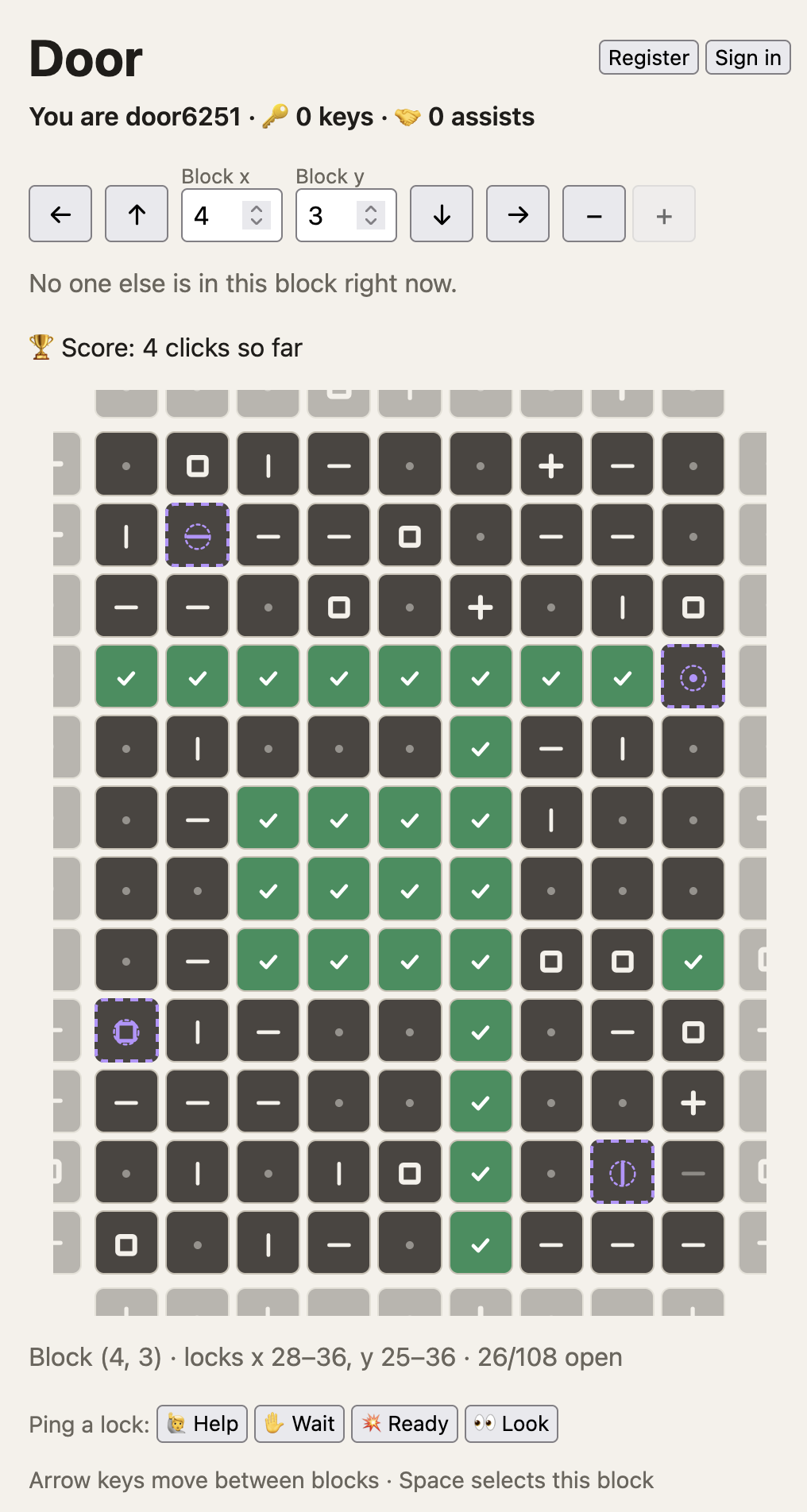
I'm also writing a puzzle game with a door that has one million locks. It's real-time multiplayer; some locks have opening combos, and others can be opened only by > 2 players. I'm writing it to practice with PostgreSQL. I only have an HTML prototype to test it. https://6251.s3.eu-west-1.amazonaws.com/hn-door-screenshot.p.... If you are interested, I can publish the code.
I thought I’d get where I wanted much faster, but it turns out I ran into quite a few challenges: it’s quick to build something simple, but it takes much longer to get a reader that’s robust and pleasant to use (extraction, parsing, security, infrastructure, etc.).
On the tech side, I’m using my usual stack, Laravel and Livewire, with some Python for extraction and Go for the email infrastructure. This month I’m working on the beta release, since several people around me were already using it, so I’d like to gather more feedback.
I'm not really interested in making any money off of this site at any point but it has been fun to see the Google analytics data as a few dozen people visit it every week to read reviews. I've reviewed like 30 different brands at this point.
*currently building a benchmark suite, reaching approx. 40% less ram usage, 40% faster input lag, less cpu usage in some activities, and faster responsiveness during high cpu usage (from other tasks)
Working on an in-browser update of our k8s course, a new C course, as well as terraform and bash courses coming down the pipe.
still lots of people learning, its not like demand has cratered, but a steady decline for sure
The idea is to bring chat, docs, files, links, tasks, whiteboards and calls into one place, organised around project channels, rather than jumping between Slack, Notion, Linear, etc. I want to build a better Slack, something that feels instant, got a hacker/IDE feel to it, and works offline.
One feature I love is that teams can build little apps with AI directly inside their workspace. Things like shared support rotas, spreadsheets, dashboards or custom workflows, all running in an isolated sandbox (with cloudflare OS) and easily accessible to the team.
I've been building it solo for around 18 months now, alongside my job as a staff engineer. The web app is live, and there's a macOS app too. It's built with Tauri, so I will eventually release apps for other platforms but I need more time to test it properly.
I had a team try it and they loved it, but in the end their leadership wasn't comfortable adopting something built by a solo developer as a side project. I understand, and it's a tricky problem for me to solve at this point. I've added a lot of security/trust info, uptime history etc. to the website as a result of that.
I'm looking for a few small teams willing to give it a go. Happy to help setting things up or answer any question. I'd also love any feedback, good or bad...!
I got a 360 camera (GoPro MAX v1) for my bicycle, after re-discovering bicycling during COVID. I soon found it was fun to review the video after a ride, but the software was a bit clunky. Upgraded to a DJI Osmo 360, and found the software likewise powerful, but still not what I wanted.
As an audio video developer I knew I could make it work the way I wanted, and this year I finally set about doing that: https://recap360.app (macOS-only at the moment).
It’s a ~5MB download from the macOS app store; no in-app ads, no accounts, no ~GB download. It loads the video of a 5-hour bike ride in seconds, direct from MicroSD. Complete with a map overlay & graphs of various internal metadata. (Speed, altitude, ascent rate, but also internal temperature etc).
It’s been fascinating to see the various tradeoffs the camera vendors make; how much in-camera stabilization & rolling shutter compensation vs how much to leave to the player. Also interest ing is how the metadata is recorded in the file; some document them, most don’t.
Started with GoPro MAX, added DJI Osmo 360 & Insta360 support. More coming soon. Even plays dash cams & body cams (Vantrue & Boblov; I was curious to see how they stored GPS data).
Bonus: it might run on some linux machines directly? (I'm even less clear about how well that'd work, and supporting it would be a bear. I could open source it, but imho nobody needs more abandonwear).
I got overwhelmed by walls of text of parallel Claude Code sessions. This limited the sessions I could steer in parallel to maybe 5 or 6. I knew there had to be a better way, and I found one: A canvas per project. Work laid out as cards. An agent in a worktree per card. Chat condensed to WhatsApp-style back and forth, not a litany of tool calls. Result is usually a narrated demo video that I can comment on by voice to have the agent go another round. Remote-control from my phone. Remote workers to scale beyond my machine. Everyone I know who tried it has stuck with it so far.
I building a service to let different AI agents talk to each other. You can use it to connect your own agents, e.g. Muse and Grok Bot, or make Claude review Codex’s work. Or you can use it to connect to your friend’s or colleague’s agents - think Grok Bot team but without the requirements that everyone has to be part of the same org.
Why not use mail? Well, for one, it’s hard to register many different emails programmatically, and you do want a separate inbox for each of your agents. And you shouldn’t really give your agents access to your primary email: it’s not secure, and you will be drowned in noise past a certain email volume.
There is a lot of competition in this space already; it’s heating up. Wish me luck!
* https://unofax.com - A simple a la carte fax service
* https://unopost.com.au - A way to send physical mail online (and avoid standing in line at the post office)
* https://snailgram.com.au - Custom greeting cards, with the message inside written by a 3D printer holding a pen.
There are a handful of others too, but these are the ones that are live so far. I've contributed between 5-40% to these projects.
This weekend I am modifying the pipelines to be able to operate on downsampled sensor layers so that I can get multi shot editing as snappy as possible. If you are only displaying 500ish pixels wide, its wild to still be rendering the full 16mp image. Perfetto has been very helpful while optimizing.
Last weekend I was able to make what I feel like is a generational leap in reducing the noise from these sensors. https://www.dpreview.com/forums/threads/foveonic-process-you...
Up next is redoing the caching/scheduling architecture to reduce the amount of overhead and to support multiplexing downsampled editing so that the images are processed within the same GPU pass instead of N passes * M images serially.
Most USB microscopes come with poor software, often limited to one brand or operating system. G-Scope works with almost any UVC microscope and several Wi-Fi models too, it has photo/video capture, calibrated measurements, annotations, and more advanced features like panorama stitching and PDF reports. Some pro features require a one-time purchase.
Everything is local, without account, no subscription, cloud or telemetry.
It's accumulated a decent number of users now which is exciting.
Under the hood it's an Elixir backend with a network of little go probes running all over the world, all connected by TCP tunnels. All the check result data is stored in Clickhouse. Status pages are generated on demand and served through a CDN.
The whole thing is EU hosted.
I’m still looking for work in the mean time but I’m proud of what I’ve achieved so far.
https://getcrewbird.com/
I have something vibed together as an internal tool that does well enough, but definitely not something I would ever refer to as a CRM by any stretch of the imagination and the bridge between basic on-the-shelf inventory and tracking rental assets are two completely different beasts. Maybe more of a prettier version of the spreadsheets we already use with more automated functionality would be more apt.
Definitely share when you do. If you have a repo or anything that I can follow while it is still in development, that would be great.
For example, we started with our contacts app and it's really hard to get right. Some of the things we thought about:
- It has to be fast, getting to any contact should take 2 clicks maximum (we implemented a Windows Start Menu-search esque system - hit '/' to search, enter your query, and hit enter)
- Search results are tailored to your search (if you searched for city, you'll see the city for each contact in the search results, if you search by tag, you'll see tags, etc.)
- The entire contacts list is virtualized at the DOM and data layer - you can scroll through 10s of thousands of contacts without having to mash prev/next page.
- We put a ton of care into each field - each field is smart. The address field detects if an address has a missing line 2 (it's an apartment, etc.), we have a pretty elegant system for handling multiple addresses, distinguishing billing/shipping, and so on. This is just one field.
- You get a snapshot of a contact's activity through every other app. I can open an email client as a window above my contact app and email them like I could in Gmail.
We've carried this approach through each one of our apps, and it's coming out incredibly good. Not quite ready to share it yet, but I believe it's 100x easier to use than existing systems.
My real advice… start working for him and using the software yourself 100%. Even for $5 an hour so you both have skin in the game. Him to have some help, you to learn, but the money adds a bit of reality so neither of you do things only because it’s free or because it’s family.
My saas has improved leaps and bounds this year when I started to work in the industry for a company actually using my product. I learned things I never saw by just giving demos.
Its really not hard to sit down and listen to users but I have encountered such massive egos and resistances to simple moving a button somewhere else or changing a flow or behavior to be easier to use for a layman that the juice is never worth the squeeze. Often to get the flow that I want to use I just resort to hacking apart the Api bit by bit and making my own horrible layer on-top of the existing solution because i am still standardized but I don't have to deal with politics in making a change request.
Out of curiosity, where did you get the name Crewbird?
I did consider a startup attentive at the start of the year and decided against it.
Nice story but also kindof sad you didn't have time for this while you were working. Good example of what can happen if we don't work so much.
Maybe his father didn't want to worry his family, and had been keeping it to himself. I have no idea, and neither do you; you just chose to assume the worst about someone you don't know.
I did no such thing. My assumption was that OP, like most of us, dedicates most of his life to work. That's not a character judgment and it's not "the worst". It's normal.
In the absence of work he was able to help his dad, presumeably because he had more time. The "sad" part isn't OP, it's the fact that work demands so much.